
Overtoun Bridge: What’s on the Other Side of the Wall?
The Shadow Archives: Strange & Sinister | Truth in the Shadows
Content note: This story discusses animal injury and death.
Hey y’all. Today, we’re heading to Scotland, to a bridge I would absolutely admire from a distance. And if I had a dog, they would be admiring it from an even greater distance.
Imagine taking your dog for a walk. They’re sniffing around, you’re enjoying the scenery, maybe noticing the trees and the old stonework. Nothing about this outing feels unusual.
Then, suddenly, they jump over the wall of a bridge.
You rush to look over.

There’s a steep drop on the other side.
What do you do in that moment? Call their name? Reach for them? Freeze for half a second because your mind hasn’t caught up with what you’re seeing?
Before we even get to the ghosts, there’s the fear of watching an animal you love disappear somewhere you cannot immediately reach.
And all you were doing was taking them for a walk.
Overtoun Bridge stands near Dumbarton, Scotland, crossing a deep valley over the Overtoun Burn. Completed in 1895, it has a large central arch with smaller arches on either side. Beautiful stonework, a wooded setting, and a reputation that would have me checking exactly where I was standing.
Its designer was Henry Ernest Milner. Before joining his father’s landscape practice, he worked as an assistant railway engineer in Russia and Nova Scotia. His later commissions included work at Wembley Park and Edinburgh’s Princes Street Gardens. His father, Edward Milner, had worked under Joseph Paxton, whose projects included the Crystal Palace.
So the man behind this crossing had experience with both engineering and elaborate landscapes.
The bridge also had a practical purpose. The estate’s existing approach was considered too steep for carriages. A new western route was created, carrying visitors across the valley toward Overtoun House.
And that house had been there for decades before Milner’s bridge.
James White bought Overtoun in 1859. The mansion, built between 1860 and 1863, was designed in the Scottish Baronial style by architect James Smith. White’s son, John Campbell White, later Lord Overtoun, inherited the estate and commissioned the bridge.
The family’s money came from chemical manufacturing at Shawfield. While the Whites supported churches and local causes, conditions at their works drew fierce criticism from Keir Hardie. Historical research documents the harm suffered by the chemical workers whose labor helped sustain that fortune.
There’s also a separate true-crime connection. James Smith, the architect of the house, was the father of Madeleine Smith, who stood trial in 1857 accused of poisoning her lover, Emile L’Angelier. Her case ended with a “not proven” verdict. That connection belongs to the house’s architect, not Milner, who designed the bridge decades later.
The house eventually served very different purposes. During World War II, it was used as a convalescent home, including for injured military personnel. In April 1948, it opened as a maternity hospital. Its maternity role continued until 1970.
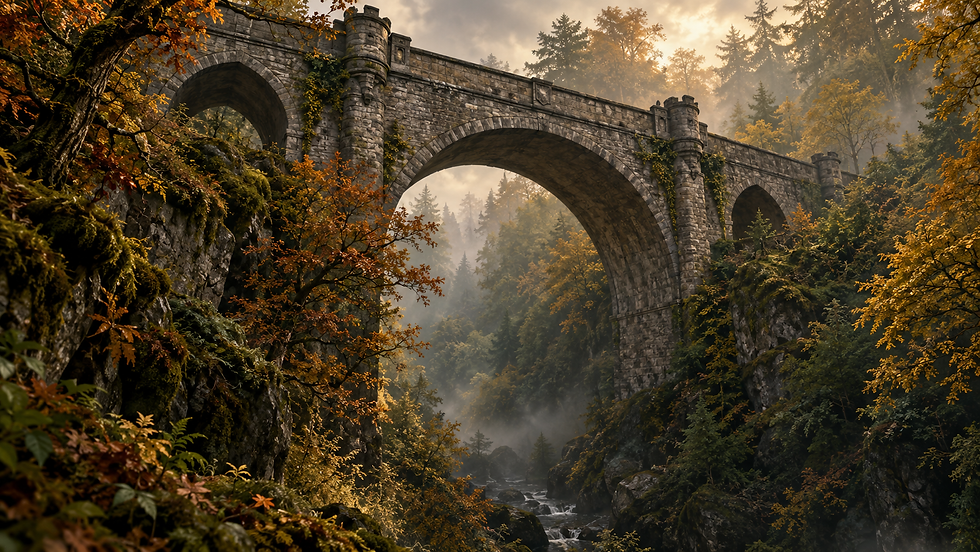
We’ll explore the house and the family behind it separately. For now, we’re heading back to the bridge and the reputation that came much later.
Overtoun became widely known as the “dog suicide bridge.”
Later accounts commonly place the beginnings of the dog incidents in the 1950s, more than half a century after the bridge was completed. That date appears in the 2019 New York Times reporting, but it doesn’t establish an exact first incident.
And that nickname makes an enormous assumption about what the dogs understood.
An animal jumping over a wall cannot explain its intentions afterward. We’re left trying to interpret a moment an owner may barely have had time to see.
In 2015, Sky News reported the experience of Alice Trevorrow, whose springer spaniel, Cassie, survived a fall from the bridge. Trevorrow described a sudden jump, followed by her son finding Cassie below. Sky also reported a warning sign asking visitors to keep their dogs on a lead.
Four years later, the New York Times report republished by SBS told the story of Lottie Mackinnon and her Border collie, Bonnie. Mackinnon described Bonnie abruptly jumping from the parapet. She went down into the gorge expecting the worst, but Bonnie survived.
Imagine the relief of finding your dog alive after that—and then having to walk away without knowing what made them jump.
Did they see something? Hear something? Were they trying to reach something beyond the wall?

And, well, this is an old Scottish estate. Of course there’s a ghost story.
The White Lady of Overtoun belongs to the folklore surrounding the estate. Author Paul Owens promotes a supernatural explanation involving Lady Overtoun. His website also describes the bridge as a “thin place,” somewhere the boundary between this world and another supposedly becomes easier to cross.
According to that interpretation, the dogs could be responding to something their owners cannot perceive. A supernatural cause, however, has not been established.
You can almost picture the scene people have in mind: mist gathering around the stone, trees disappearing into the gray, a pale figure glimpsed somewhere near the house.
Once someone tells you a place is haunted, every sound gets a promotion. A rustle becomes movement. A shadow becomes a figure. Your dog stops and stares at something you cannot see, and suddenly you’re wondering whether you should have stayed in the car.
But what if the thing attracting their attention is something alive beneath the bridge?
Animal behaviorist David Sands proposed that mammal scents below could attract dogs, while the walls and their limited perspective might prevent them from recognizing the drop.
You know you’re crossing a bridge. You understand what the walls are there for. You can look at the surrounding landscape and recognize that the ground falls away beneath you.
Your dog might be concentrating on something else entirely.
Something small. Something hidden beyond the stone.
We’ve all watched a dog stop to sniff something and refuse to move on. We might not notice anything there, but whatever they’ve picked up has their full attention.
Now imagine that curiosity drawing them toward a wall. They jump to investigate, unaware of the drop on the other side.
That’s the possibility Sands’s theory raises. It offers a way an ordinary behavior could become dangerous in this setting, although it doesn’t establish what happened in every reported fall.
Even the scale of the incidents is difficult to pin down. Published estimates vary, and the reporting discussed here does not supply a complete incident register establishing an exact total. A 2026 local investigation also questions the scale of the bridge’s reputation.
Repeating a number across enough articles doesn’t turn it into a verified count.
Still, behind the accounts are owners who described watching their pets go over the wall.
That dog has a name.
They have a spot where they sleep. A ridiculous habit. A particular sound they make when someone comes home. There’s probably a person who complains about the fur and then saves them a place on the couch anyway.
For that person, Overtoun is the place where something terrifying happened to an animal they loved. The ghost story doesn’t explain how they’re supposed to feel comfortable taking that next walk.
There may be details missing from individual accounts. Different falls may have had different causes. And years of retelling may have added certainty where there wasn’t much to begin with.
The White Lady remains part of the folklore, while the scent and perspective theory offers a possible physical explanation. Neither gives us a verified account of every incident.
If you visit with a dog, keep them securely leashed and away from the parapet. You don’t need an answer to the mystery before taking that precaution.
What do you make of Overtoun Bridge? Does the scent explanation make sense to you, or is there a part of the story you’d want investigated more closely?
Follow Truth in the Shadows for more from The Shadow Archives: Strange & Sinister.
Where secrets whisper loudest in the dark.

Comments