
Before Madam C.J. Walker: Annie Turnbo Malone and the Black Beauty Empire History Forgot.
- Feb 13
- 4 min read
Updated: Mar 1

Fast Facts
Before Madam C.J. Walker became a household name, Annie Turnbo Malone built the blueprint for America’s Black beauty industry. Born in 1869, Malone developed science-based hair and scalp treatments specifically for Black women at a time when safe products did not exist. She founded the Poro Company and Poro College, creating one of the earliest national Black-owned business networks. Her system trained tens of thousands of women in entrepreneurship, financial independence, and professional skill. Despite her enormous influence, Malone’s legacy was gradually overshadowed. Her story reveals how innovation, mentorship, and erasure often coexist in American history.
At a Glance
Born: 1869, Metropolis, Illinois
Founder: Poro Company and Poro College
Industry: Hair care, cosmetics, business education
Impact: Trained over 75,000 Black women globally
Known For: Laying the foundation for the modern Black beauty industry
Legacy Issue: Overshadowed by protégés despite pioneering the system
Why This Matters
History prefers clean success stories. But real progress is rarely clean and almost never singular.
Annie Turnbo Malone matters because her story exposes how Black women’s labor, ideas, and mentorship are often absorbed into larger narratives without full credit. She built the infrastructure that made later success possible, yet her name remains unfamiliar to many who benefit from the industry she created.
This is not about diminishing anyone else’s achievements. It is about accuracy.
When we erase architects and only celebrate the final builders, we distort how power is actually created and who is allowed to be remembered for it.
Annie Turnbo Malone: Building Beauty from Science
Annie Minerva Turnbo was born in 1869 in Metropolis, Illinois, the tenth of eleven children. Her parents had been enslaved, but Annie was born free. From an early age, she demonstrated a talent for chemistry and hair care two disciplines rarely associated with Black women in the late nineteenth century.
At a time when homemade remedies and harsh chemicals damaged Black women’s hair and scalps, Malone began experimenting with gentler formulations. She believed hair care was not about assimilation but about health, dignity, and self-respect.
Her products gained popularity through word-of-mouth, particularly among Black women searching for safer alternatives in a market that ignored their needs.
The Poro System and a National Empire
By the early 1900s, Malone formalized her business into what became known as the Poro System, named after a West African concept symbolizing growth and harmony.
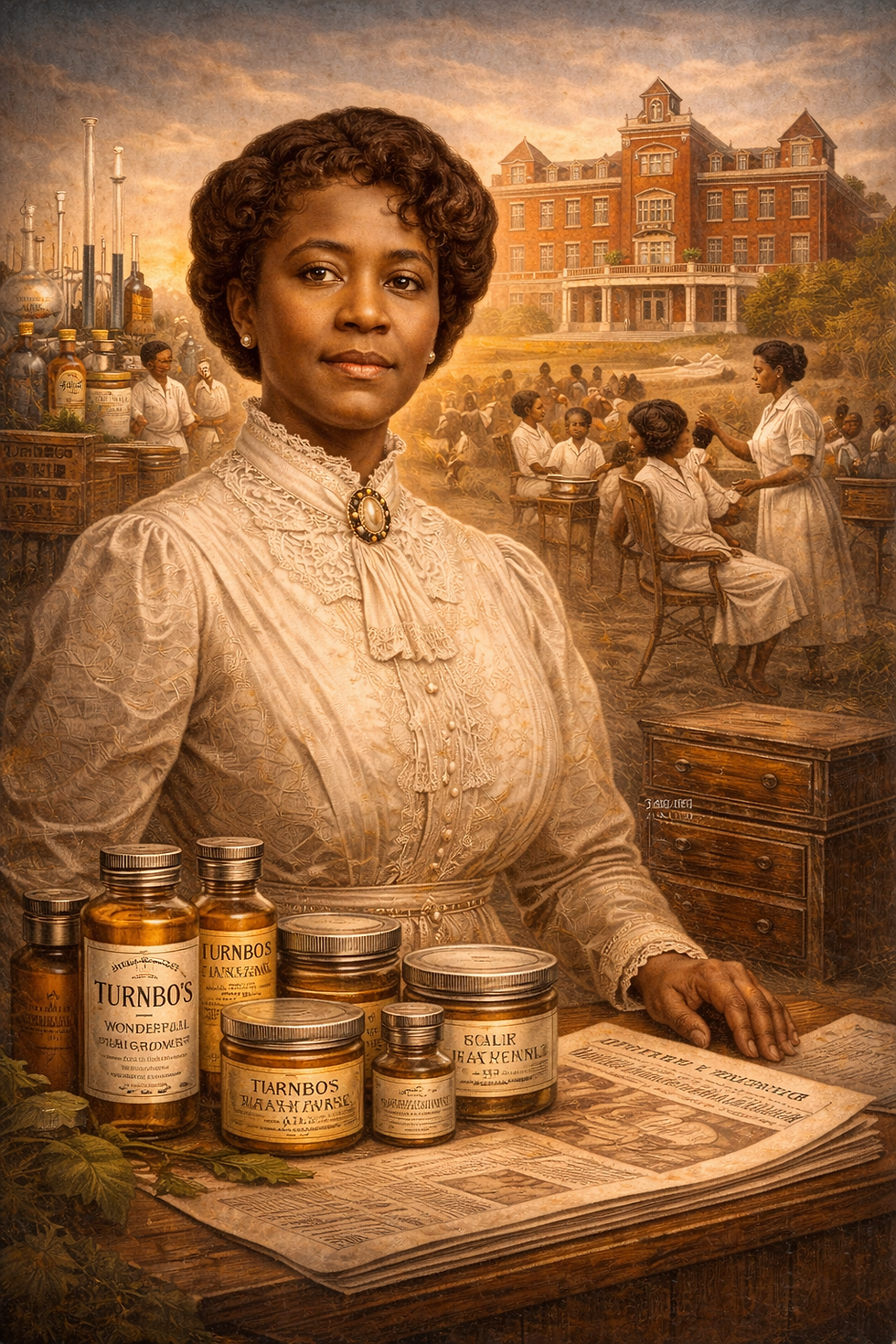
In 1910, she opened Poro College in St. Louis a five-story complex that housed manufacturing operations, training schools, housing for employees, and community meeting spaces. It became one of the first large-scale commercial and educational institutions owned by a Black woman in the United States.
Through the Poro Company, Malone trained thousands of women as sales agents, teaching not only hair care but also bookkeeping, professionalism, and business ownership. At its height, the Poro system employed hundreds and reached tens of thousands of women worldwide.
The Complicated Legacy with Madam C.J. Walker
Among Malone’s early sales agents was Madam C.J. Walker. Walker learned sales techniques, branding strategies, and distribution methods while working within the Poro system before eventually leaving to create her own company.
Walker’s success would become historic, earning her recognition as the first self-made female millionaire in the United States. What history often fails to emphasize is that Annie Turnbo Malone created the pathway that made such success possible.
This relationship was not simply rivalry. It reflected the realities Black women faced in limited economic spaces where mentorship, separation, and competition often coexisted.
Philanthropy, Power, and Quiet Decline
Malone was also a committed philanthropist. She donated millions to Black schools, churches, and charitable institutions, including substantial support for the St. Louis Colored Orphans Home.
Despite her wealth and influence, her later years were marked by legal disputes, divorce, and financial losses. Unlike some contemporaries, Malone lived long enough to witness the decline of her empire and the fading of her public recognition.
When she died in 1957, the magnitude of what she had built was already slipping from popular memory.
What History Forgot
Annie Turnbo Malone’s story reflects a broader pattern in American history:
Innovators are often remembered less than brand figures. Mentors fade while protégés become legends. Black women’s systems are absorbed without attribution.
Her erasure was not accidental. It was structural shaped by sexism, capitalism, and a preference for simplified narratives that elevate singular heroes over collective foundations.
Reflection: Restoring the Record
Annie Turnbo Malone was not “before the Madam. ”She was the architect.
She built the infrastructure, trained the workforce, and proved Black women could create global business networks long before legal protections existed.
Her story does not diminish later success. It deepens it.
References
African American Intellectual History Society. “Untangling Madam C. J. Walker’s Story.”
Encyclopedia Britannica. “Annie Turnbo Malone.”
National Museum of African American History and Culture. “Annie Turnbo Malone.”
National Women’s History Museum. “Annie Turnbo Malone: Entrepreneur and Philanthropist.”
Missouri Historical Society. “Poro College and Annie Turnbo Malone.”

Comments